🔌 Network Services
MOS provides various network services for remote access, file sharing, and VPN connectivity. These can be managed through:
Settings → Network → Network Services
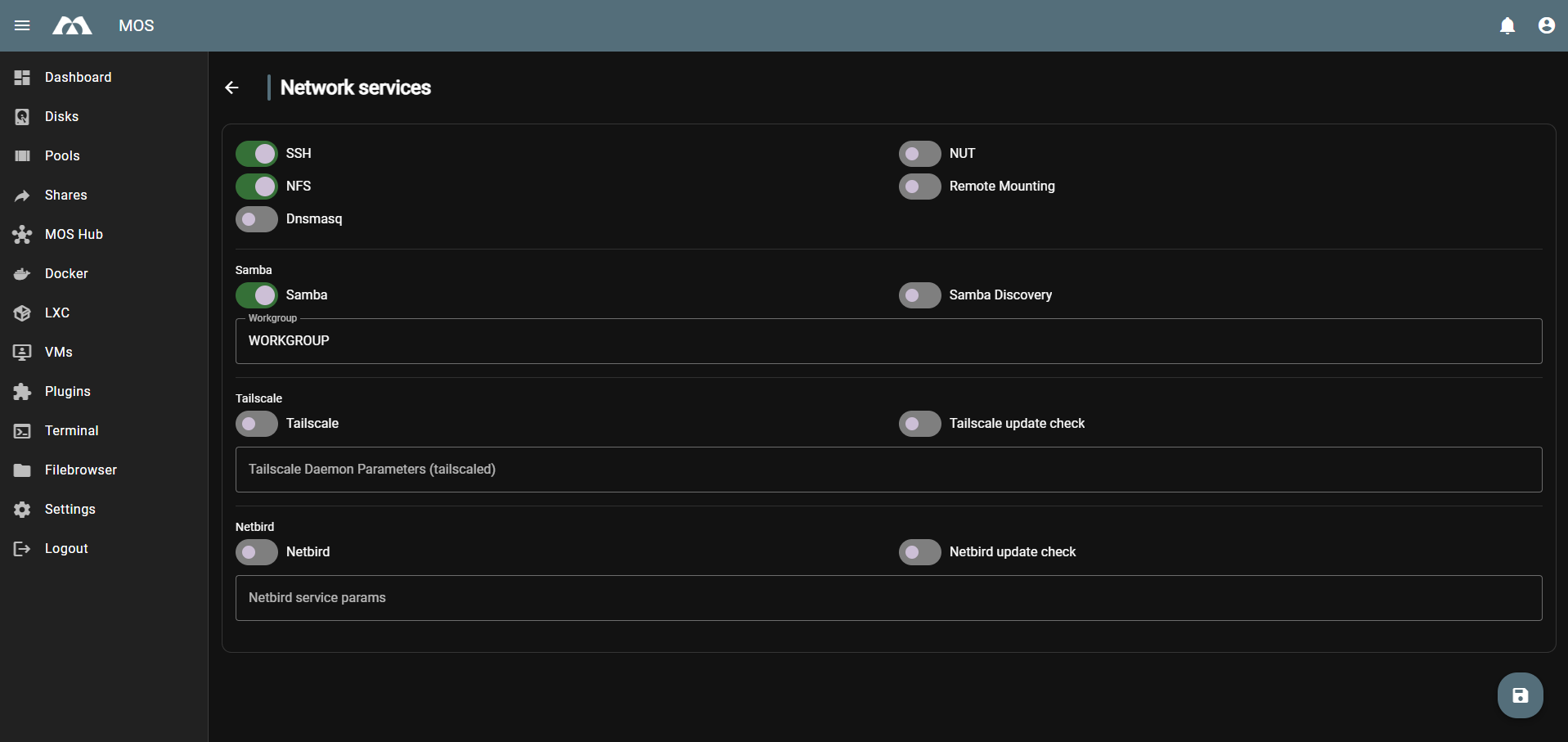
🔒 SSH
Enable SSH access to remotely manage your MOS system via command line.
When enabled, you can connect using any SSH client:
ssh root@<MOS-IP-ADDRESS>
NFS
Network File System (NFS) allows Linux/Unix systems to mount shares from MOS.
Enable NFS to share directories with other systems on your network.
🌍 Dnsmasq
Lightweight DNS forwarder and DHCP server.
Enable Dnsmasq for local DNS resolution and DHCP services.
🔋 NUT (Network UPS Tools)
Monitor and manage UPS (Uninterruptible Power Supply) devices connected via USB or serial port.
Enable NUT in Settings → Network → Network Services to integrate with local UPS devices for power management and automatic shutdown.
Configuration Files
NUT configuration files are located at: /boot/config/system/nut/
1. ups.conf - UPS Device Configuration
Defines the UPS devices to monitor:
[ups]
driver = usbhid-ups
port = auto
Key settings:
driver- Driver for your UPS type (e.g.,usbhid-upsfor USB HID devices)port- Serial port (e.g.,/dev/ttyS0) orautofor USBmaxretry- Number of start attempts (default: 3)retrydelay- Delay between attempts (default: 5 seconds)pollinterval- Status refresh interval (default: 2 seconds)
2. nut.conf - NUT Mode
Sets the operating mode:
MODE=standalone
Modes:
standalone- Single UPS protecting the local system (most common)netserver- UPS server accessible over networknetclient- Client monitoring remote UPS servers onlynone- NUT disabled
3. upsd.conf - UPS Daemon Configuration
Network settings for the NUT server:
LISTEN 0.0.0.0 3493
Key settings:
LISTEN- IP address and port to listen on (default: 3493)MAXAGE- Mark data stale after X seconds (default: 15)ALLOW_NO_DEVICE- Allow server to start without UPS devices
4. upsd.users - User Access Control
Defines users and permissions:
[admin]
password=adminpass
actions=set
actions=fsd
instcmds=all

[slaveuser]
password = slavepass
upsmon slave

[monuser]
password = monpass
upsmon master
Permissions:
actions=SET- Change UPS variablesactions=FSD- Force shutdowninstcmds=ALL- Execute all commandsupsmon primary/secondary/master/slave- Monitoring role
5. upsmon.conf - UPS Monitoring
Controls system monitoring and shutdown behavior:
MONITOR ups@127.0.0.1 1 monuser monpass master
MINSUPPLIES 1
SHUTDOWNCMD "/sbin/shutdown -h +0"
NOTIFYCMD /sbin/upssched
POLLFREQ 5
DEADTIME 15
FINALDELAY 5

NOTIFYFLAG ONBATT SYSLOG+EXEC
NOTIFYFLAG ONLINE SYSLOG+EXEC
NOTIFYFLAG LOWBATT SYSLOG+EXEC
Key settings:
MONITOR- UPS to monitor (format:upsname@host powervalue username password role)MINSUPPLIES- Minimum power supplies needed to stay runningSHUTDOWNCMD- Command to execute on critical power eventPOLLFREQ- Check interval in seconds (default: 5)DEADTIME- Declare UPS dead after X seconds without responseFINALDELAY- Wait time before shutdown (default: 5 seconds)NOTIFYFLAG- Actions on events (SYSLOG, WALL, EXEC, IGNORE)
6. upssched.conf - Scheduled Events
Defines actions for UPS events:
CMDSCRIPT /bin/upssched-cmd
# PIPEFN /run/nut/upssched/upssched.pipe
# LOCKFN /run/nut/upssched/upssched.lock

# Example: Start timer when on battery
# AT ONBATT * START-TIMER onbattwarn 30
# AT ONLINE * CANCEL-TIMER onbattwarn
Commands:
CMDSCRIPT- Script to execute for timer eventsPIPEFN/LOCKFN- Required paths for timer mechanismAT <event> <ups> <action>- Event handlers
Common UPS Drivers
| Manufacturer | Driver | Notes |
|---|---|---|
| APC | usbhid-ups | Most modern APC units |
| APC (older) | apcsmart | Smart-UPS via serial |
| CyberPower | usbhid-ups | Most USB models |
| Eaton | usbhid-ups | Various models |
| Tripp Lite | usbhid-ups | USB HID models |
| Tripp Lite | tripplite | Serial models |
| Generic USB | usbhid-ups | HID-compliant devices |
Testing NUT
After enabling NUT and configuring your UPS:
# Check UPS status
upsc ups@localhost

# List available commands
upscmd -l ups@localhost

# Test battery (if supported)
upscmd ups@localhost test.battery.start

# View NUT logs
tail -f /var/log/nut.log
Troubleshooting
- UPS not detected: Check USB connection and driver compatibility
- Permission denied: Verify user settings in
upsd.users - No shutdown: Check
SHUTDOWNCMDandNOTIFYFLAGsettings - Stale data: Increase
MAXAGEor checkpollinterval
📀 Remote Mounting
Mount remote storage to your MOS system.
Enable to access storage from other servers or NAS devices.
🗂️ Samba (SMB/CIFS)
Windows-compatible file sharing.
Samba
Enable Samba to share folders with Windows, macOS, and Linux systems.
Samba Discovery
Enable network discovery for automatic detection of MOS shares.
Workgroup
Configure the workgroup name for your network (default: WORKGROUP).
🌐 Tailscale
Tailscale is a zero-config VPN that creates a secure mesh network between your devices.
Enabling Tailscale
- Go to Settings → Network → Network Services
- Toggle Tailscale to enable the service
Setup
After enabling Tailscale, open the MOS Terminal and run:
tailscale up
This will generate an authentication URL. Follow the link to authenticate your device with your Tailscale account.
For additional options and parameters, refer to the official Tailscale documentation: tailscale up
Tailscale Update Check
Enable automatic update notifications for Tailscale.
Tailscale Daemon Parameters
Add custom command-line arguments for the Tailscale daemon (tailscaled) if needed.
🐦 Netbird
Netbird is an open-source peer-to-peer VPN solution with zero configuration.
Enabling Netbird
- Go to Settings → Network → Network Services
- Toggle Netbird to enable the service
Setup
After enabling Netbird, open the MOS Terminal and run:
netbird up
This will generate an authentication URL. Follow the link to register your device with your Netbird management server.
For additional options and parameters, refer to the official Netbird documentation: netbird up
Netbird Update Check
Enable automatic update notifications for Netbird.
Netbird Service Parameters
Add custom configuration parameters for the Netbird service if needed.
🆘 Troubleshooting
VPN not connecting?
- Ensure the service is enabled in Network Services
- Check that you've run the
upcommand in the MOS Terminal - Verify your device has internet connectivity
- Check firewall settings if behind a restrictive network
Can't access shares?
- Verify the sharing service (NFS/Samba) is enabled
- Check share permissions in the Shares section
- Ensure client devices are on the same network or VPN
Parts of this documentation were created with the assistance of AI tools. All AI-generated content has undergone review, but it may still contain inaccuracies, omissions, or outdated information.